

What size rugby ball is best for a 5-year-old? Learn why Size 2 and Size 3 are the only safe options for U6s, and which materials to avoid.
What Size Rugby Ball is Best for a 5-Year-Old?
If you are buying equipment for a kindergarten, a youth club (U6s), or a primary school PE program, you already know the golden rule: Do not give a 5-year-old an adult-sized ball.
Handing a standard Size 5 ball to a 5-year-old is like handing them a giant watermelon. They can’t grip it, they can’t throw it properly, and it can actually hurt their fingers or face when they try to catch it.
As a direct custom rugby ball manufacturer, we supply schools and clubs worldwide. Here is the definitive answer on sizing for 5-year-olds, and what you need to know before placing a bulk order.
The Short Answer: Size 2 or Size 3
For a 5-year-old, you should only be looking at two options: Size 2 (Mini) or Size 3.
- Size 2 (The Mini Ball): This is the absolute best choice for a 5-year-old. It is roughly 25 cm long and weighs about 250–280g. It fits perfectly in small hands and allows them to learn the correct throwing and catching motion safely.
- Size 3: This is the standard size for U8s and U9s. If you have a mixed group of 5 to 7-year-olds, Size 3 is acceptable. It is slightly longer (26 cm) and heavier (310-350g). However, some smaller 5-year-olds might find it a bit difficult to grip at first.
Never order Size 4 or Size 5 for a 5-year-old. They are too heavy and too large for their motor skills.
The Material Matters More Than You Think
When buying for young children, you shouldn’t just focus on size—you must focus on the material. Adult leather balls are too hard.
We highly recommend soft PVC or natural rubber for this age group. These materials are softer to the touch, making it less painful if a child gets hit in the face during a catching drill. They are also waterproof, which is perfect for muddy school fields. You can check out our soft-touch options in the bulk custom rugby balls collection.
What About Tags and Touch Rugby?
At 5 years old, kids are mostly playing “Tag Rugby” or “Touch Rugby” to learn the basics. They are not doing full-contact tackling. Therefore, the ball doesn’t need to be ultra-durable; it just needs to be easy to catch and fun to play with.
If you are ordering for a school or a club, we can customize these smaller balls with your club mascot or school logo. It gives the kids a huge sense of pride to play with “their” team ball. You can see how well small logos print on our eco-friendly rugby balls for schools.
How to Order for Your Youth Program
Most factories force you to buy hundreds of balls of the same size. We don’t. Our MOQ (Minimum Order Quantity) is just 10 pieces per design.
If you are a coach or a school coordinator, you can mix it up. Order 20x Size 2 for the 5-year-olds, and 30x Size 3 for the older kids, all with the same logo.
Ready to get a quote for your youth program? Send us your requirements and we will give you a price and a free digital proof within 12 hours.
Get a Free Quote & Sizing Advice →
Need a custom size you don’t see on the website? Contact us—we can manufacture custom weights and sizes for specific training needs.
Confused about rugby ball sizes? Learn the differences between Size 3, 4, and 5 for Rugby Union and League, and how to order the right mix for your team.
What Are the Sizes of Rugby Balls? A Practical Guide for Buyers
If you are ordering equipment for a school district or a multi-team club, getting the right size is crucial. Handing a Size 5 ball to a 7-year-old is a quick way to teach them bad habits (and bruise their confidence).
As a direct custom rugby ball factory, we get asked about sizing every single day. Here is the straightforward breakdown of rugby ball sizes, who they are for, and how they differ between codes.
The Standard Size Chart (By Age & Level)
In most youth and school programs, the sizes are determined by age. Here is the standard reference:
| Ball Size | Typical Age Group | Length (Approx) | Weight (Approx) |
|---|---|---|---|
| Size 3 | 6 – 8 years (Mini/U8s) | 26 cm (10.2 in) | 310 – 350 g |
| Size 4 | 9 – 14 years (Junior/U9-U14) | 28 cm (11 in) | 360 – 400 g |
| Size 5 | 15+ years (Adult/Senior) | 29 cm (11.4 in) | 410 – 460 g |
Rugby Union vs. Rugby League: Is There a Difference?
Yes, there is a slight difference. If you are sourcing in Australia or New Zealand, you need to know this.
- Rugby Union (Size 5): The traditional ball is slightly longer and more oval. The standard dimensions are 280–290mm in length, with a length-to-width ratio of about 1.6 to 1.
- Rugby League (Size 5): Often referred to as the “NRL style” ball. It is generally slightly smaller, shorter, and more rounded than a Union ball. This makes it easier to handle and pass quickly.
If you are ordering for a club that plays both codes, or a school that runs both programs, we can print your logo on both styles. You can browse the different options in our bulk custom rugby balls collection.
Pro-Tip for B2B Buyers: Order a “Mixed Size” Batch
If you are a school or a large youth club, do not order 100 balls of the same size. You likely have different age groups playing at the same time.
Most factories (including us) allow you to mix sizes in one bulk order. You can order 30x Size 3, 40x Size 4, and 30x Size 5, all with the same school logo. It saves you on shipping and ensures every kid has a ball that fits their hands. We’ve written a full guide on how this works if you want to check out our custom printed rugby balls.
What About Mini Size 1?
You might occasionally see “Size 1” or “Mini” balls. These are usually promotional items, souvenirs, or toys for toddlers. They are not used for actual matches, but if you want to give away a small branded ball at a tournament, they are cheap and popular.
How to Order the Right Sizes
Tell us who is playing (U8s, U12s, or Seniors) and which code they play (Union or League). We will recommend the exact size and material that fits your budget. All balls can be fully customized with your team crest, and we offer a free digital proof before you pay.
Ready to order? Send us your requirements and get a quote within 12 hours.
Get a Free Quote & Size Recommendation →
Need a custom size chart for your school’s specific program? Contact us and we will help you plan your order.
Stop paying to ship air! Learn how we pack bulk custom rugby balls. We deflate every ball and pack exactly 50 pieces per carton to cut your freight costs.
If you are ordering hundreds of rugby balls from China to your club or warehouse, the factory’s packing method will directly dictate how much you pay for shipping. Get it wrong, and you are literally paying hundreds of dollars to transport air across the ocean.
As a direct custom rugby ball manufacturer, we have optimized our packing process to save our B2B clients as much money as possible. Here is the exact breakdown of how we pack and transport bulk orders, focusing on two golden rules: Deflation and 50 Balls Per Carton.
Rule 1: We Deflate Every Single Ball
You might think your balls should arrive fully pumped and ready to go, but that is a terrible idea for international freight.
A fully inflated rugby ball is mostly air. If you ship 500 inflated balls, you need a massive amount of cubic volume (CBM). Sea freight and air freight charge by volume. By shipping them inflated, you are throwing money away.
We deflate all wholesale rugby balls before packing. Deflating them shrinks their size by more than half. They can be packed flat and stacked tightly.
Will they lose their shape? No. High-quality balls with a proper bladder and wound carcass will bounce right back to perfect shape once you pump them up at your facility. You just need a standard air pump, and you save up to 50% on your shipping costs.
Rule 2: Exactly 50 Pieces Per Carton
How many balls should go into one box? We standardize our master cartons to hold exactly 50 deflated rugby balls per carton.
Why this specific number? It comes down to warehouse ergonomics and weight limits. A carton of 50 standard size 5 rugby balls weighs roughly 20 to 25 kg (44 to 55 lbs).
If we pack 100 balls in a box, it becomes too heavy for a single worker to lift safely. Your warehouse team will hate it, and couriers often charge extra handling fees for overweight boxes. If we pack too few, you waste money on cardboard and handling. Fifty is the sweet spot.
We use standard 5-layer corrugated cardboard to ensure the boxes don’t crush during transit. Inside the box, the deflated balls are packed securely to prevent the logos from rubbing against each other or getting scuffed.
How to Transport Them (Choosing the Freight)
Once your boxes are packed with 50 pieces each, how do they get to you?
- Sea Freight (LCL/FCL): The most common method for bulk orders. Since the balls are flat, you can fit hundreds of cartons on a single pallet. Transit time is 20–40 days.
- Air Freight: Great for 100–300 balls when you need them for a specific tournament. Transit time is 10–15 days.
- Express (DHL/FedEx): Only for small sample orders (under 50 balls).
To make things even easier, we offer DDP (Delivered Duty Paid) shipping. We handle the customs clearance, pay the duties, and deliver the pallets right to your school or club. You just sign the paperwork.
Need a Custom Packing Solution?
While 50 per carton is our standard, we can customize the packing if you have specific requirements. For example, if you are a distributor and want 10 balls per inner box, with 5 inner boxes in a master carton, we can do that.
If you want to see what this looks like in practice, check out our custom NRL style rugby league ball. It packs perfectly flat and inflates beautifully.
Ready to get a shipping quote? Send us your delivery address and the total quantity you need, and we will calculate the exact freight cost and pack plan for you within 12 hours.
All orders ship with clean commercial invoices and correct HS codes to prevent customs delays.
Dropped passes cost games. Discover which rugby ball material offers the best grip and anti-slip performance in wet, muddy, or dry conditions.
Which Rugby Ball Material Has the Best Grip?
In rugby, a dropped pass can lose you the game. While player skill is the main factor, the ball itself plays a massive role. If the surface is slick, players will hesitate, and handling errors will pile up.
If you are sourcing balls for a school or a club, you need to know: Which material provides the best grip and anti-slip performance?
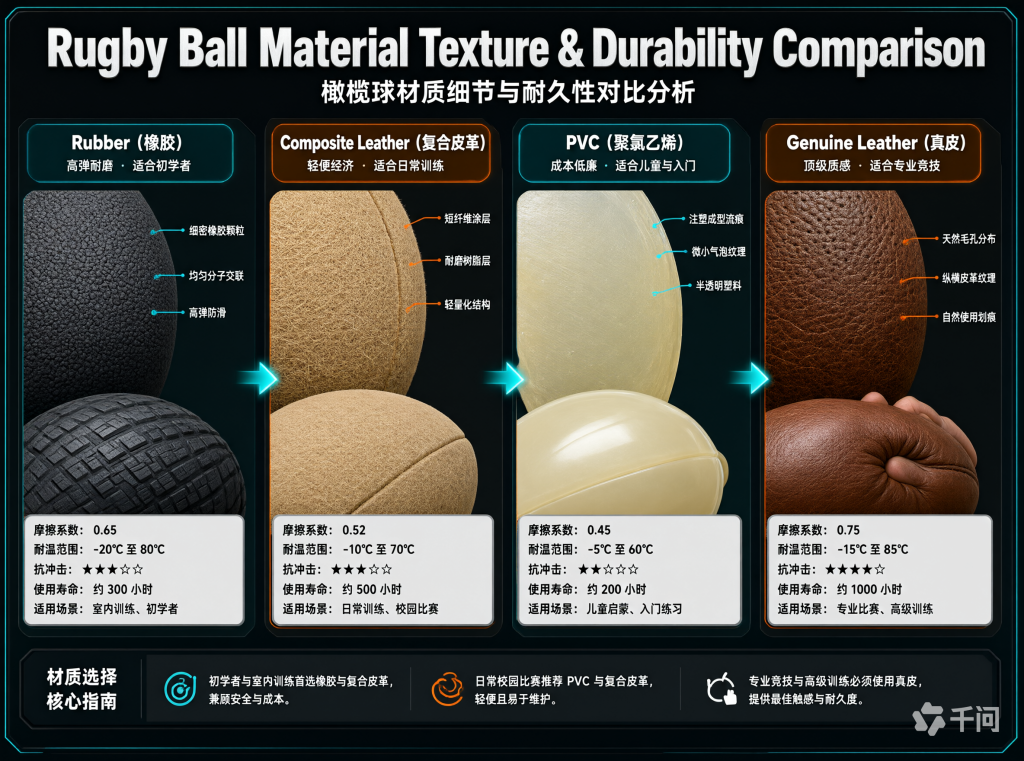
As a rugby ball manufacturer, we test hundreds of ball surfaces every year. Here is the honest breakdown of how different materials perform when things get sweaty or wet.
1. Genuine Leather: The Ultimate Grip (Under Specific Conditions)
Nothing beats the grip of a high-quality genuine leather ball. Here is the secret: leather actually gets tackier as it absorbs a little bit of moisture (sweat or light rain). It molds to the player’s hand and provides an incredible feel.
The Catch: It only works well in light moisture. If it’s pouring rain or the ball is left in a puddle, leather absorbs too much water, becomes heavy, and turns into a slippery brick. Plus, it requires constant conditioning. It’s perfect for dry-weather match days, but not reliable for general training.
2. Composite Leather: The Best All-Weather Grip
For 90% of clubs and schools, composite leather is the best choice for grip.
Composite leather is a synthetic material engineered with a pebbled surface (those tiny bumps). It provides a soft, tacky feel right out of the box. Unlike genuine leather, it doesn’t need to be “broken in.” It also repels water rather than absorbing it, meaning it stays grippy even in wet weather.
If your players are complaining about dropping balls during rainy training sessions, you should switch to composite leather. You can check out our custom logo composite leather rugby ball, which is specifically designed for this kind of all-weather handling.
3. Rubber: Great for Mud, Harder for Handling
Rubber balls are the kings of durability, but their grip is a mixed bag.
High-quality natural rubber offers a decent grip, especially in wet and muddy conditions where it cuts through the water. However, rubber is generally harder than leather. It doesn’t absorb sweat well, so if players’ hands get very sweaty, a rubber ball can feel slippery. It is great for physical, muddy training, but less ideal for precision backline passing drills.
4. PVC: The Worst for Grip (Avoid for Training)
PVC is essentially hard plastic. While it is very cheap, it is incredibly slick. When it gets wet or sweaty, it feels like holding a bar of soap. Do not buy PVC balls if you care about passing and handling.
What Else Makes a Ball Grippy?
Material isn’t the only factor. When looking at custom rugby balls, look for these two things:
- Pebbled Texture: The deeper the dimples, the more surface area there is for fingers to grip.
- Seam Quality: Hand-stitched seams sit tighter and flush with the surface, making the ball easier to hold compared to machine-stitched balls where the seams can protrude.
The Verdict
If you want the best anti-slip performance across all weather conditions, go with composite leather. It balances professional-level grip with the durability needed for club and school budgets.
We supply composite leather balls with low MOQs (10 pcs per design), so you can test the grip for yourself before committing to a full season’s order. Send us your club logo, and we’ll get a quote and a digital proof to you within 12 hours.
Get a Free Quote & Grip Advice →
Want to test the grip? Order a sample today and feel the difference.
Choosing the wrong material for rugby training can drain your club’s budget. Discover why rubber and composite leather are best for daily practice.
Which Material is Best for Rugby Training Balls? A Coach’s Guide
If you are managing a rugby club or a school program, you know that replacing training gear eats into your budget every single year. The biggest culprit? Training balls getting worn out, losing their grip, or absorbing water on muddy pitches.
When you are ordering bulk custom rugby balls, choosing the wrong material for your training sessions is a costly mistake. You don’t need the most expensive ball; you need the most durable one.
As a direct custom rugby ball manufacturer, we supply clubs and schools across the UK, Australia, and New Zealand. Here is the honest truth about which materials survive the daily grind.
1. Rubber: The Undisputed King of Training
If your team trains outdoors on grass, hard ground, or in wet weather, rubber is the best material you can buy.
Why? Because it is practically indestructible. Rubber balls don’t absorb water, so they don’t get heavy and sluggish when it rains. The outer cover handles abrasion (like scuffs from concrete or hard pitches) far better than leather. They don’t require any conditioning or “breaking in.”
Verdict: If you need 50 balls that will survive a whole season of daily drills, buy rubber. It’s the most cost-effective choice per training session.
2. Composite Leather: The Premium Training Option
Composite leather is a synthetic material designed to feel like real leather. It offers a softer, tackier grip compared to rubber.
It is slightly less durable than pure rubber, but it is still a great choice for advanced training, especially for the backs who need to practice kicking and handling. If your club has a mix of training on grass and lighter artificial turf, composite leather is a solid choice. It also takes custom logos beautifully, which is great for team pride. You can see how well it prints on our eco-friendly rugby balls for schools.
Verdict: Buy composite leather if your players complain about the hard feel of rubber, but be prepared to pay a bit more and expect a shorter lifespan on rough outdoor grounds.
3. PVC: Good Only for Kids & PE Classes
PVC is the cheapest material on the market. It is often used for promotional balls or primary school PE classes.
Verdict: Do not buy PVC for serious club training. It feels hard, plastic-like, and the grip wears off quickly. It is only suitable if your budget is extremely tight and the balls are just for kids to kick around during recess.
4. Genuine Leather: The Worst Choice for Training
Genuine leather is what the professionals use on match day. It has the best grip and feel. However, never use genuine leather for daily training.
It absorbs water, gets heavy in the mud, and will peel or crack if left outside. It is also expensive. Save your leather balls for the Friday night game, and use rubber for the Tuesday practice.
The Training Ball Cheat Sheet
| Material | Waterproof? | Lifespan (Daily Use) | Recommendation |
|---|---|---|---|
| Rubber | Yes | 1-2 Seasons | Best Overall |
| Composite Leather | Water-resistant | 6-12 Months | Advanced Training |
| PVC | Yes | Short | Kids / Youth Only |
| Genuine Leather | No | Very Short | Match Day ONLY |
How to Order for Your Club
If you are buying for a school or a multi-team club, our advice is to order a bulk batch of rubber balls with your club logo printed on them. It saves money, reduces replacement costs, and ensures the kids always have a dry, grippy ball to practice with.
We keep our MOQ low (just 10 pieces per design), so you can test our rubber balls before committing to a massive order. Send us your club crest or school logo, and we will send you a free digital proof and a quote within 12 hours.
Get a Free Quote & Training Ball Advice →
All our balls ship deflated to save you up to 50% on freight. Perfect for stocking up the clubhouse before the season starts.
Choosing the right rugby ball material is crucial for clubs and schools. Compare PVC, rubber, composite leather, and genuine leather to find the best fit.
What is the Best Rugby Ball Material
If you are sourcing rugby balls for a school, a local club, or a sports distributor, the first and most important question you’ll face is: What material should I choose?
You will often see four main materials on the market: PVC, Rubber, Composite Leather, and Genuine Leather. Choosing the wrong one means either wasting your budget or giving your players a ball that doesn’t perform.
As a custom rugby ball manufacturer, we produce thousands of balls every month. We don’t believe in “one size fits all.” Here is a straightforward breakdown of each material to help you make the right decision.
1. PVC (Polyvinyl Chloride) – The Budget-Friendly Trainer
If you are buying for a primary school PE class or a youth camp where kids are just learning the basics, PVC is usually the best choice. It is the most affordable option.
The Good: Extremely cheap, easy to clean, and comes in bright colors. It is great for mass distribution.
The Catch: It feels a bit hard and slippery compared to natural materials. It’s not ideal for professional play, but for a school with a tight budget, it’s a lifesaver.
2. Rubber – The Tough Workhorse for Outdoors
Rubber balls are incredibly popular in Australia and New Zealand because they are virtually indestructible. If your teams play on hard grounds, concrete, or in wet weather, this is the material to look at.
The Good: Exceptional durability and water resistance. A good rubber ball can survive a whole season of muddy training sessions without peeling or losing its shape.
The Catch: It doesn’t absorb sweat as well as leather, so it can get a bit slick during intense summer matches. It’s perfect for training, but some players prefer a softer feel for actual games. You can browse our durable options in the bulk rugby balls section.
3. Composite Leather – The Best All-Rounder
This is the sweet spot for most adult clubs and high schools. Composite leather is a synthetic material designed to mimic the feel of real leather, but without the high cost and maintenance.
The Good: It offers a soft, tacky grip right out of the box (no break-in period needed). It is more durable than genuine leather and holds up well in light rain. It also takes logo printing beautifully, making it a top choice for custom branding.
The Catch: It is slightly more expensive than PVC or rubber. But for the performance upgrade, it is worth every penny.
4. Genuine Leather – The Pro Standard
This is what the pros use (like in NRL or Super Rugby). It offers the ultimate grip and feel.
The Good: The tackiness improves as the ball gets slightly wet or sweaty. Nothing beats the feel of a genuine leather ball in a serious match.
The Catch: It is expensive, requires regular conditioning, and will be ruined if left out in the rain or mud. It is only recommended for high-level match balls, not daily training.
Quick Comparison Table
| Material | Best For | Durability | Cost |
|---|---|---|---|
| PVC | Youth training, PE classes | Moderate | $ |
| Rubber | Outdoor training, wet weather | Excellent | $$ |
| Composite Leather | Club matches, high school | Very Good | $$$ |
| Genuine Leather | Professional matches only | Fragile (needs care) | $$$$ |
So, Which One Should You Order?
Here is my advice based on what we see from our clients:
- For Schools: Mix it up. Buy PVC for the younger kids and Rubber for the older students.
- For Local Clubs: Composite leather is the best investment for daily training and weekend games.
- For Distributors: Stock a bit of everything. Rubber sells best in winter, and Composite Leather sells best for custom team branding.
If you want to see exactly how a high-quality rubber or composite ball feels, take a look at our custom NRL style rugby league ball. It is waterproof, durable, and takes a printed logo perfectly.
Still not sure? Send us a message. Tell us who is playing and where they are playing, and we will recommend the exact material that fits your budget.
Get a Free Quote & Material Advice →
Discover professional tips on how to maintain your basketball to prevent breakdowns. Learn proper cleaning, air pressure control, and storage methods to extend the lifespan of your custom balls.
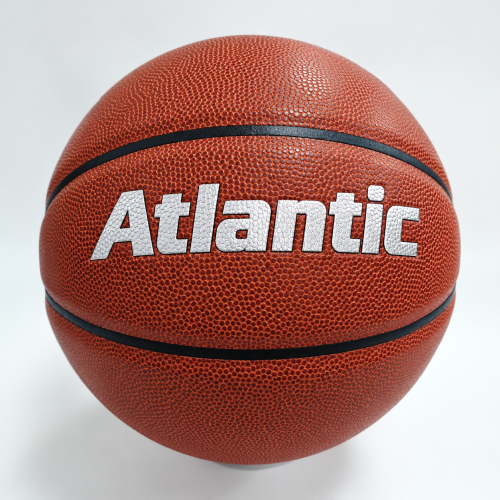
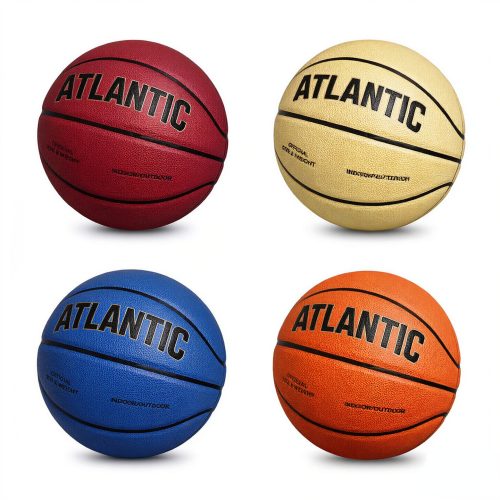
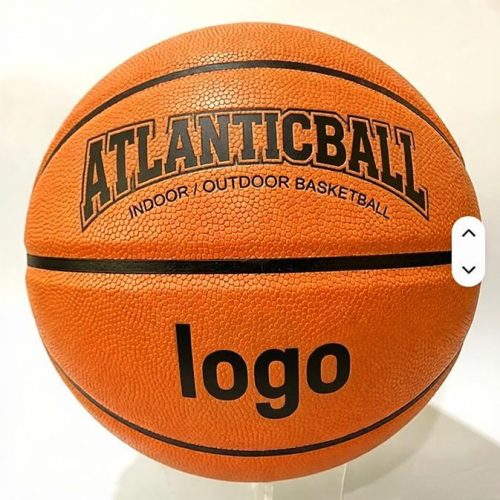
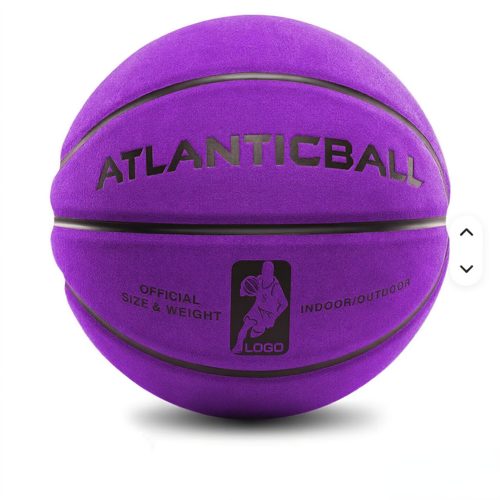
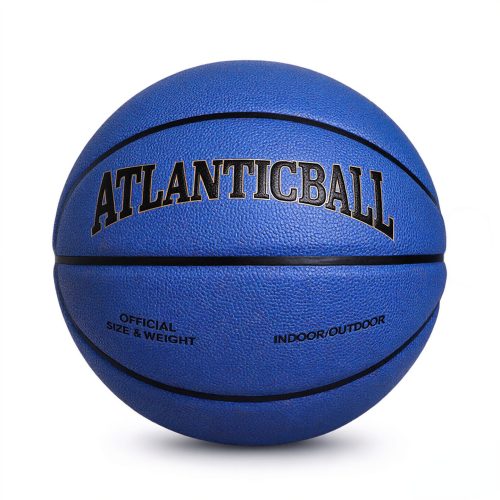
Whether you are managing a school PE department, running a local sports club, or supplying sporting goods retailers, the longevity of your basketballs directly impacts your budget. A high-quality basketball can last for years if cared for properly, but neglect can lead to cracked leather, loss of grip, and a dead bounce in just a few months. As a leading custom basketball manufacturer, Atlantic Ball shares professional maintenance tips to help you protect your investment and maximize the lifespan of your balls.
1. Clean the Surface and Deep Channels
Dust, sweat, and outdoor dirt mix into the pores of the leather or composite material, ruining the ball’s grip and accelerating wear.
- The Routine: After every heavy training session, wipe the ball down with a damp, soft microfiber cloth.
- Deep Cleaning: Use a soft-bristled brush with a tiny drop of mild soap and water to gently scrub the deep channels where dirt accumulates.
- What to Avoid: Never use harsh chemical cleaners, bleach, or abrasive sponges, as they will strip the protective coating off the PU or leather cover.
2. Monitor and Maintain Optimal Air Pressure
Incorrect air pressure is one of the most common causes of ball failure. Over-inflating causes the seams to stretch and burst, while under-inflating breaks down the inner bladder and ruins the bounce.
- Check Regularly: Test the bounce and firmness every week. A standard basketball should have 7 to 9 PSI of air pressure.
- Use the Right Pump: Always use a proper needle and a pump with a pressure gauge. Moisten the needle with a drop of water or saliva before inserting it to prevent damage to the air valve.
- Storage Pressure: When storing balls for the off-season, do not let them go completely flat. Keep them slightly under-inflated (around 5-6 PSI) to maintain the bladder’s elasticity.
3. Proper Storage and Material-Specific Care
Where and how you store your basketballs matters just as much as how you play with them.
- Avoid Extreme Temperatures: Never leave basketballs in the trunk of a car or direct sunlight. Extreme heat dries out the leather and rubber, causing premature cracking, while extreme cold makes the material brittle.
- Use the Right Court: Composite leather and microfiber balls (like our premium bulk custom logo basketballs) are designed for indoor courts. Playing with them on rough outdoor asphalt will shred the cover in weeks. Save outdoor rubber balls for street play.
- Storage Location: Store them in a cool, dry place. A dedicated ball rack is ideal, but a clean equipment bag works perfectly to keep dust off.
Partner with a Reliable Manufacturer for Long-Lasting Balls
While regular maintenance can significantly extend the life of your equipment, it all starts with the manufacturing quality. At Atlantic Ball, we use high-grade materials and strict quality control to ensure our balls can handle rigorous use. If you are looking to upgrade your inventory, check out our top-rated custom PU leather basketballs built for durability and premium performance.
Need Durable Basketballs for Your Next Season?
Contact our sales team today to get wholesale pricing, discuss OEM logo printing, and request a free product sample.
Wondering about the MOQ for custom rugby balls? We keep our minimum order quantity at just 10 pieces per design. Mix sizes, test quality, and order direct.
Let’s be straight with you: if you are a school coach or a local club manager, you probably don’t need 1,000 rugby balls. Maybe you just need 30 for a summer camp, or 50 for a youth team. But you still want your team’s logo on them.
The biggest roadblock buyers face when sourcing from China is the MOQ (Minimum Order Quantity). Many factories will tell you they need a 500 or 1,000-piece minimum. We don’t.
As a custom rugby ball manufacturer, we keep our MOQ intentionally low: just 10 pieces per design. Here is exactly how it works, and why we do it.
Why Low MOQ Matters for B2B Buyers
When you are sourcing rugby balls for a school or a club, the budget is always tight. A high MOQ forces you to tie up thousands of dollars in inventory that might take years to use. It also stops you from testing the quality of a new supplier.
By keeping the MOQ at 10 pieces, you can:
- Order a small trial batch to test our stitching and print quality.
- Order exactly what your team needs for the season, without wasting money.
- Try out different sizes or materials before committing to a massive container order.
Can I Mix Sizes and Materials Within the 10-Piece MOQ?
Yes. This is where a lot of suppliers give you a hard time, but we are flexible.
If you are ordering for a school, you might need Size 3 for the little kids, Size 4 for the middle grades, and Size 5 for the seniors. You can mix these sizes in one order as long as the total quantity hits 10 pieces per design.
You can also mix materials. For example, you can order 5 PVC training balls and 5 composite leather match balls in the same batch to see which one your players prefer. If you want to see the different material options, you can browse our full range of bulk custom rugby balls.
What if I Want Different Names and Numbers on Every Ball?
If every ball needs a different player name or a unique sponsor logo, the setup is slightly different. Because we have to create individual print templates for each ball, the MOQ for personalized names/numbers is usually a bit higher (often around 30–50 pieces per design).
However, if you just want one team logo on all the balls, the 10-piece MOQ applies. You can check out our custom printed logo rugby balls to see the standard print quality we deliver.
Why We Keep Our MOQ Low
We know that trust is built one order at a time. A club manager who orders 20 balls today might be the one ordering 500 balls for a tournament next year. We would rather earn your trust with a small, low-risk trial order than force you into a big commitment.
Once you see the quality of the balls and the sharpness of the logo, we know you will come back for your next season.
How to Start Your Trial Order
Ready to test the waters? Send us your logo file (AI, PDF, or high-res PNG) and let us know the sizes you need. We will send you a free digital proof and a quote within 12 hours.
Don’t have a vector file? Don’t worry—our design team can usually recreate it for you for free. Just send us what you have.
Have a unique requirement? Send us a message and we will figure out a way to make it work for your program.